Introduction
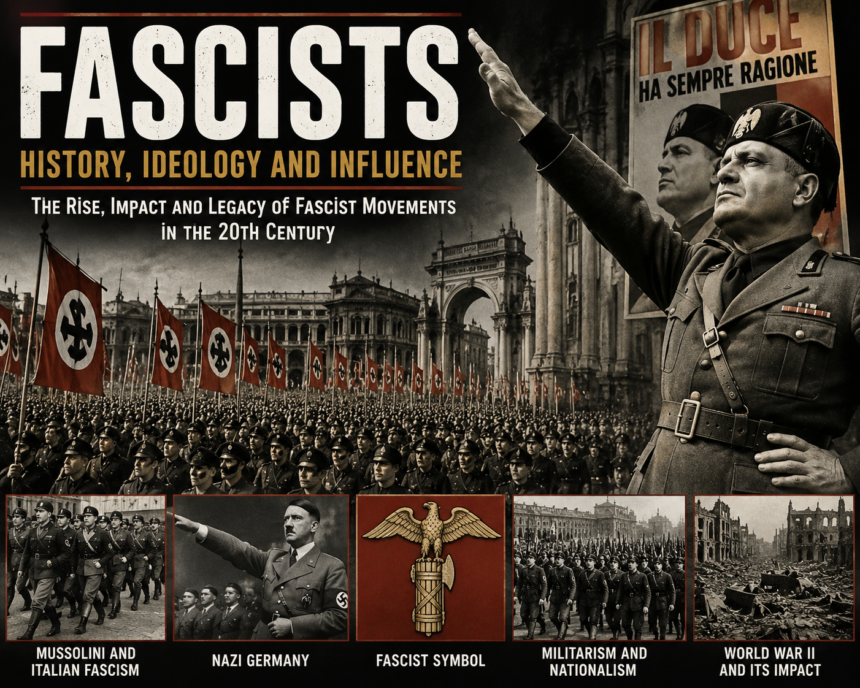
The term Fascists refers to supporters and members of fascist political movements. Fascism was an authoritarian and extreme nationalist political ideology that became particularly influential in Europe during the early 20th century. Fascist movements promoted strong centralized leadership, national unity, political obedience, and the idea that the interests of the state should take priority over individual political freedoms.
The history of fascism is closely connected to the political and economic instability that followed the First World War. Although fascist movements appeared in different countries and were not identical, they shared several important characteristics.
What Is Fascism?
Fascism is a political ideology associated with authoritarian government, extreme nationalism, strong leadership, militarism, and opposition to liberal democracy and communism. Fascist movements generally rejected political pluralism and believed that society should be organized around a powerful state and a unified national identity.
Fascist governments often used propaganda, censorship, political organizations, and state-controlled institutions to influence society. Opposition parties and independent organizations were frequently restricted or eliminated.
However, fascism did not have exactly the same meaning or structure everywhere. Different movements developed their own beliefs, policies, and forms of government.
The Origins of Fascism
Modern fascism first became a major political movement in Italy after the First World War. Italy experienced serious economic difficulties, social tensions, unemployment, and political conflict during the post-war period.
These conditions created an environment in which some people became attracted to movements promising order, national strength, and political stability.
In 1919, Benito Mussolini established the Fasci Italiani di Combattimento. The movement eventually developed into the National Fascist Party. Fascists promoted nationalism, discipline, and a strong state while presenting themselves as an alternative to both liberal democracy and socialism.
In 1922, the March on Rome helped Mussolini gain political power. Over the following years, he gradually dismantled democratic institutions and established an authoritarian dictatorship.
Benito Mussolini and Italian Fascism
Benito Mussolini became the most famous early leader of fascism. He was known as Il Duce, meaning “the leader.”
Under Mussolini, Italy became a one-party dictatorship. Political opposition was heavily restricted, independent organizations were weakened, and censorship was expanded. The government also used propaganda to promote the fascist state and Mussolini’s leadership.
Fascist organizations attempted to influence different parts of society, including education, youth activities, media, and public life. Large political gatherings and symbols were used to create a sense of national unity and loyalty.
Mussolini also pursued an aggressive foreign policy. Italy invaded Ethiopia in 1935, demonstrating the regime’s desire to expand Italian power abroad.
Fascists and Nazi Germany
Fascism also influenced political developments elsewhere in Europe. The most significant example was Germany under Adolf Hitler and the Nazi Party.
Nazism shared several characteristics with Italian fascism, including authoritarian leadership, extreme nationalism, militarism, propaganda, and the suppression of political opposition. However, Nazism was a distinct ideology with a particularly central emphasis on racial hierarchy and antisemitism.
Hitler became Chancellor of Germany in 1933 and rapidly transformed the country into a dictatorship. The Nazi regime persecuted Jewish people and numerous other groups. This persecution eventually became the Holocaust, during which approximately six million European Jews were murdered.
The history of Nazi Germany demonstrates the devastating consequences of racist ideology, dictatorship, political repression, and aggressive expansion.
Main Characteristics of Fascist Movements
Although fascist movements differed from one another, several characteristics commonly appeared.
Authoritarian Leadership
Fascist governments generally concentrated political authority around a powerful leader. The leader was often presented as the person capable of restoring national strength and unity.
Extreme Nationalism
Fascists placed exceptional importance on the nation. National interests were presented as more important than individual political interests.
Suppression of Opposition
Fascist governments generally opposed political competition. Opposition parties, independent newspapers, trade organizations, and other groups could face censorship, restrictions, or repression.
Propaganda
Propaganda played an important role in fascist politics. Governments used newspapers, radio, posters, speeches, films, and public events to promote official ideas and influence public opinion.
Militarism
Military strength and discipline were frequently celebrated by fascist movements. Armed conflict and national expansion could be presented as signs of strength.
Fascists During World War II
Fascism played a major role in the political developments that led to the Second World War. Italy under Mussolini became an ally of Nazi Germany, and the two regimes cooperated militarily.
Germany’s expansion into neighboring countries and the aggressive policies of the Axis powers contributed directly to the outbreak and development of the war.
The conflict caused enormous destruction across Europe. Millions of civilians and soldiers died, cities were destroyed, and populations were displaced.
By 1943, Italy’s military and political situation had deteriorated significantly. Mussolini was removed from power, although German forces later helped establish a fascist government in northern Italy. The remaining fascist regime collapsed in 1945 as the war ended in Europe.
The Decline of Fascism After 1945
The defeat of the Axis powers in 1945 marked a major turning point for fascism. The crimes committed by Nazi Germany and the destruction caused by the war discredited fascist and related authoritarian movements across much of Europe.
In Italy, the fascist regime ended and the country eventually established a democratic republic. In Germany, the Nazi Party was dissolved and prohibited.
Post-war Europe placed greater emphasis on democratic institutions, constitutional government, human rights, and international cooperation. The experience of fascist dictatorships became an important subject of historical study.
Fascism in Modern Discussions
Fascism remains an important subject in history and political science. The word is also frequently used in modern political debates, but historians generally emphasize the importance of using the term carefully.
Not every authoritarian or nationalist movement is automatically fascist. Researchers usually examine a combination of characteristics, including extreme nationalism, authoritarian leadership, rejection of democratic pluralism, political repression, and the glorification of national power.
Understanding the historical meaning of fascism helps prevent the term from being used inaccurately.
Why Is the History of Fascists Important?
Studying fascists and fascism is important because it provides insight into some of the most significant political events of the 20th century. It demonstrates how economic uncertainty, social conflict, political instability, propaganda, and the weakening of democratic institutions can contribute to the rise of authoritarian movements.
Learning about fascism also helps people understand the importance of democratic institutions, freedom of expression, political participation, and the protection of human rights.
Conclusion
The Fascists were part of political movements that had a profound impact on European history during the 20th century. Fascism first became a major political force in Italy under Benito Mussolini and later appeared in different forms across Europe. Its characteristics included authoritarian leadership, extreme nationalism, political repression, propaganda, and militarism.
The rise and fall of fascist regimes, particularly in Italy and Nazi Germany, shaped the course of European history and the Second World War. Studying this history remains important because it helps explain the dangers of political extremism and dictatorship while highlighting the importance of democratic institutions, human rights, and historical awareness.