Introduction
Infrastructure is the foundation of a modern economy. Roads, bridges, public transportation, energy systems, water networks, hospitals, schools, and digital connectivity all play an important role in supporting everyday life. A priority infrastructure plan provides a structured approach for identifying, funding, and completing the projects that are most important for economic development and public well-being. By focusing resources on high-impact projects, governments and organizations can improve essential services while preparing communities for future challenges.
What Is a Priority Infrastructure Plan?
A priority infrastructure plan is a strategic framework used to determine which infrastructure projects should receive attention and investment first. Instead of treating every project equally, the plan evaluates projects according to factors such as urgency, economic value, public benefit, safety, environmental impact, and available funding.
The goal is to make infrastructure investment more organized and effective. A well-designed plan can prevent resources from being wasted on low-priority projects while ensuring that critical infrastructure receives timely improvements.
Why Infrastructure Planning Matters
Strong infrastructure supports almost every part of society. Businesses depend on reliable transportation, electricity, internet services, and water systems. Residents need safe roads, public facilities, healthcare services, and dependable utilities.
Poor infrastructure can create serious problems. Damaged roads increase transportation costs, unreliable electricity can interrupt businesses, and inadequate water systems can affect public health. In growing cities, outdated infrastructure may also contribute to traffic congestion, pollution, and housing challenges.
A priority infrastructure plan helps address these issues by identifying the areas where investment can produce the greatest results.
Key Areas of Infrastructure Investment
A comprehensive plan can cover several major infrastructure categories.
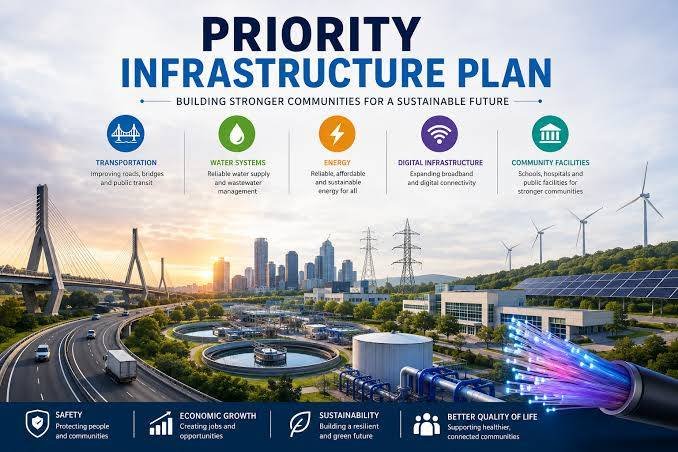
Transportation
Transportation is often one of the highest priorities. Roads, bridges, railways, airports, and public transportation systems connect people and businesses. Improving transportation can reduce travel times, increase safety, and support trade.
Priority projects may include repairing aging bridges, expanding public transit, improving major highways, and developing safer pedestrian and cycling infrastructure.
Energy and Utilities
Reliable energy is essential for homes, businesses, hospitals, schools, and industries. Infrastructure plans can prioritize electricity generation, transmission networks, renewable energy projects, and modern energy storage systems.
Water and wastewater infrastructure are equally important. Upgrading aging pipelines, treatment facilities, drainage systems, and water storage can improve reliability and protect communities.
Digital Infrastructure
Digital connectivity has become a basic requirement for modern economies. High-speed internet and reliable telecommunications support education, remote work, healthcare, financial services, and businesses.
A priority infrastructure plan should therefore consider broadband expansion, stronger communication networks, and improved digital access for underserved communities.
How Projects Are Prioritized
Selecting infrastructure priorities requires clear and measurable criteria. One important factor is urgency. Infrastructure that presents immediate safety risks may need attention before projects with long-term benefits.
Economic impact is another important consideration. Projects that create jobs, improve transportation, attract investment, or increase productivity may receive higher priority.
Public benefit should also be evaluated. A project serving a large population or addressing an important community need can provide significant social value.
Environmental sustainability is increasingly important as well. Infrastructure investments should consider energy efficiency, climate resilience, resource conservation, and long-term environmental effects.
Funding and Financial Management
Infrastructure projects often require substantial investment. A priority plan must therefore include realistic financing strategies. Funding can come from government budgets, private investment, development programs, public-private partnerships, or other financial mechanisms.
Strong financial management is essential throughout the project lifecycle. Cost estimates should be carefully prepared, budgets should be monitored, and unexpected expenses should be managed through appropriate contingency planning.
Transparent financial reporting can also improve public confidence and reduce the risk of inefficient spending.
Sustainability and Climate Resilience
Modern infrastructure planning must look beyond immediate needs. Infrastructure should be designed to remain useful and reliable for decades.
Climate resilience can be incorporated into projects by improving drainage systems, strengthening buildings and bridges, protecting energy networks, and developing infrastructure that can withstand extreme weather.
Sustainable materials, renewable energy, energy-efficient buildings, and environmentally responsible construction methods can further reduce long-term costs and environmental damage.
Technology in Infrastructure Planning
Technology can make infrastructure planning more accurate and efficient. Geographic information systems can help planners understand locations and infrastructure conditions. Sensors and monitoring systems can provide information about roads, bridges, water networks, and energy systems.
Data analytics can also help decision-makers identify problems before they become major failures. Artificial intelligence and predictive maintenance technologies may increasingly support infrastructure management by analyzing large amounts of operational data.
Benefits of a Clear Priority Plan
A well-structured infrastructure plan can provide several benefits:
- Better use of limited financial resources
- Improved public safety and essential services
- Stronger economic growth
- More efficient transportation
- Greater access to digital services
- Increased environmental sustainability
- Better preparation for future emergencies
- Greater transparency in infrastructure investment
These benefits can reinforce one another. For example, better transportation can support businesses, create employment opportunities, and improve access to education and healthcare.
Challenges to Consider
Infrastructure planning is not without challenges. Limited budgets, rising construction costs, regulatory requirements, land acquisition, and political disagreements can delay important projects.
Another challenge is balancing short-term needs with long-term goals. Emergency repairs may require immediate spending, while major modernization projects may produce benefits over many years.
Effective communication with communities is also essential. Residents should understand why certain projects are prioritized and how they are expected to improve local conditions.
Conclusion
A priority infrastructure plan provides a practical roadmap for building stronger, safer, and more sustainable communities. By evaluating projects according to urgency, economic value, public benefit, sustainability, and financial feasibility, decision-makers can direct investment toward areas where it can have the greatest impact.
Infrastructure is more than roads and buildings; it is the system that supports economic activity and quality of life. With careful planning, transparent funding, modern technology, and a long-term vision, priority infrastructure investments can create lasting benefits for communities and future generations.