Introduction
As artificial intelligence continues to influence online search, brand visibility is no longer based only on traditional SEO factors. AI-powered systems increasingly need to understand companies, products, services, locations, and relationships as clearly defined entities. This has made data consistency an important part of modern digital marketing.
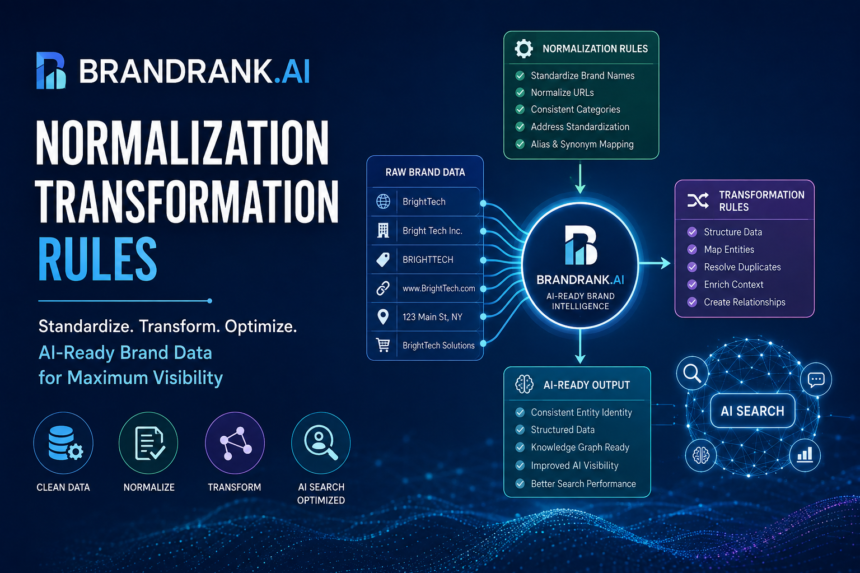
The phrase BrandRank.ai normalization transformation rules is increasingly used in discussions about AI search visibility and brand data consistency. However, it is important to clarify that publicly available information does not establish this phrase as an official technical specification published by BrandRank.ai. Instead, it is commonly discussed as a collection of practical normalization and transformation principles for making brand information easier for AI systems to understand.
What Is Data Normalization?
Normalization is the process of making information consistent. Businesses often have the same brand represented in multiple ways across websites, directories, social media accounts, databases, and marketing materials.
For example, a company might appear as:
- BrightTech
- Bright Tech
- BRIGHTTECH
- BrightTech Inc.
- BrightTech Incorporated
A person can usually recognize these names as the same company. An automated system, however, must process the available signals and determine whether they represent one entity or several different entities.
Normalization attempts to establish a preferred representation while preserving useful alternative names as aliases where necessary.
What Is Transformation?
Transformation is slightly broader than normalization. It means changing data from one structure, format, or representation into another format that can be processed by a different system.
For example, unstructured information about a company can be transformed into structured fields such as brand name, website, category, location, product, and related entities.
In an AI-focused workflow, normalization and transformation can work together. First, inconsistent information is cleaned and standardized. Then it can be organized into a structure that downstream search, analytics, retrieval, or knowledge systems can understand.
Why Brand Consistency Matters for AI Search
AI search systems work differently from traditional keyword-based search. Modern AI experiences can use information from websites, structured data, databases, knowledge graphs, and other sources to build an understanding of entities.
When a brand’s information is inconsistent, it can become harder to determine which references belong together. This may contribute to ambiguity, duplicate records, inaccurate summaries, or incorrect associations.
Normalization helps create a clearer digital identity by keeping important information aligned across multiple sources. Discussions surrounding AI brand optimization commonly connect this process with entity recognition, semantic search, structured data, and knowledge graphs.
Common Normalization Transformation Rules
Although there is no publicly documented official BrandRank.ai specification defining a universal set of rules, several practical rules are frequently associated with this concept.
1. Brand Name Standardization
A company should establish one preferred public-facing brand name.
For example:
Inconsistent:
TechNova, Technova, Tech Nova, TECHNOVA
Standardized:
TechNova
The official legal name can still be retained for contracts, regulatory documents, and other situations where it is required.
2. URL Normalization
Websites can have several versions of the same address, such as HTTP and HTTPS, www and non-www versions, or URLs containing tracking parameters.
A normalization process can identify the preferred canonical version and connect alternative versions to it.
This helps reduce unnecessary duplication when digital assets are analyzed.
3. Product Name Consistency
Products can also suffer from naming variations.
For example, a software product may appear as “Cloud Manager Pro,” “CloudManager Pro,” and “Cloud Manager.” A brand should establish an approved product name and use it consistently throughout its public content.
Historical product names can be maintained as aliases when they remain relevant.
4. Address Standardization
Businesses operating across multiple locations may have inconsistent address formats.
One source might use an abbreviated city name while another uses the full name. Street names, postal codes, and regional identifiers may also vary.
A standardized address format makes it easier to associate different listings with the same physical location.
5. Category Normalization
Companies frequently describe themselves using several related categories.
For example, one business might call itself a:
- Marketing platform
- Marketing software company
- Digital marketing solution
- Marketing automation platform
A primary category should be selected while related descriptions can be retained as supporting terminology.
6. Historical Name Mapping
Rebranding creates another normalization challenge. A company may have operated under an older name for several years before adopting a new identity.
Rather than completely removing the historical name, organizations can connect it with the current entity.
This approach helps preserve continuity while making the current identity clear.
How Transformation Supports AI-Ready Data
A typical normalization workflow can be viewed as a sequence:
Raw Data → Cleaning → Normalization → Entity Resolution → Structured Data → Retrieval and Analysis
Entity resolution is particularly important because it attempts to determine whether different records represent the same organization, product, person, or location.
For example, an AI-oriented system might encounter “ABC Ltd,” “ABC Limited,” and “ABC.” Additional information such as the website, address, industry, and other identifiers can help determine whether the references belong to one entity.
The Role of Structured Data
Structured data can provide additional context about an organization and its relationships. Consistent organization information, product details, locations, and other structured fields can make a website’s information easier for automated systems to interpret.
However, structured data should not be viewed as a magic solution. The information in markup should accurately reflect the visible and authoritative information associated with the business.
Consistency between website content, structured data, business profiles, and other public information is more valuable than simply adding large amounts of markup.
Common Mistakes to Avoid
Businesses working on brand normalization should watch for several common problems.
Using different brand names across platforms can create unnecessary ambiguity. Outdated addresses and old product names can also remain indexed long after a business has changed them. Duplicate business listings and inconsistent social profile information may create additional confusion.
Another mistake is treating every variation as an error. Some variations are legitimate, especially legal names, historical names, regional versions, and product aliases. The goal is not to erase every difference but to establish clear relationships between related representations.
A Practical Approach for Businesses
A simple normalization project can begin with a brand identity inventory. Collect the company’s official name, legal name, website, domains, products, locations, social profiles, categories, and historical names.
Next, identify inconsistent versions across important digital properties. Establish canonical values for each major field and document approved aliases.
After that, update high-value sources first, including the company’s website, structured data, major business profiles, and important third-party references.
Finally, review the information regularly. Brand data changes over time through rebranding, acquisitions, product launches, domain changes, and expansion into new markets.
Conclusion
BrandRank.ai normalization transformation rules are best understood as a useful concept within the broader movement toward AI-ready brand data rather than as a publicly confirmed official technical standard. The underlying principles are straightforward: make important brand information consistent, connect legitimate variations to canonical entities, remove unnecessary duplication, and provide accurate structured information.
As AI-powered search becomes more important, businesses will need to think beyond individual keywords and pages. A clear, consistent, and well-connected digital identity can help automated systems better understand what a brand is, what it offers, and how its different digital references relate to one another.