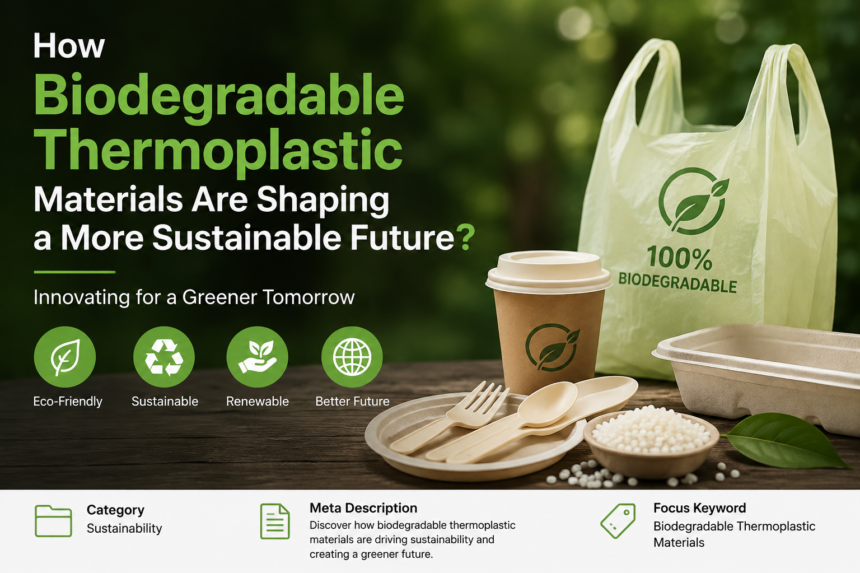
The growing demand for sustainable products has encouraged industries to search for alternatives to conventional plastics. Traditional plastic materials are durable and versatile, but their resistance to natural degradation has created a serious waste problem. Biodegradable thermoplastic materials offer a promising response by combining the processing advantages of thermoplastics with the potential to break down under suitable environmental conditions. These materials can often be softened through heat, shaped into useful products, and processed using equipment. Their development is helping manufacturers reconsider how products are designed, used, collected, and managed at the end of their service life.
Biodegradable thermoplastic materials include both bio-based and fossil-derived polymers, although the two terms should not be treated as identical. A bio-based plastic is made partly or entirely from renewable resources, but it is not necessarily biodegradable. Similarly, a biodegradable polymer may be produced from fossil-based ingredients while still having a chemical structure that microorganisms can break down. Common examples include polylactic acid, polyhydroxyalkanoates, thermoplastic starch, polybutylene succinate, and certain formulations based on PVA. Each material offers different levels of strength, flexibility, transparency, heat resistance, water sensitivity, and processing performance. Manufacturers therefore need to choose a polymer according to the product’s intended function rather than relying only on a general environmental claim.
PVA, also known as polyvinyl alcohol, is especially interesting because it is a water-soluble synthetic polymer with useful film-forming, binding, and adhesive properties. It is widely used in films, coatings, paper processing, textiles, construction materials, adhesives, and packaging applications. In selected formulations, PVA can contribute to biodegradable thermoplastic materials by improving flexibility, tensile performance, compatibility, or barrier characteristics. Its behavior can be adjusted through molecular weight, degree of hydrolysis, plasticizer content, and blending conditions. However, water solubility and biodegradability are not the same. A PVA product may dissolve in water, but its complete biological degradation depends on factors such as microbial activity, temperature, oxygen, concentration, treatment time, and the conditions available in a wastewater or composting system.
Processing performance is another important consideration. Like conventional thermoplastics, many biodegradable polymers can be produced through extrusion, injection molding, blow molding, thermoforming, or film casting. This makes commercial adoption easier because manufacturers may be able to adapt existing production lines rather than replace them completely. Nevertheless, biodegradable thermoplastic materials can be sensitive to heat, moisture, and shear during processing. PVA in particular requires careful temperature control because its melting and degradation behavior can create a narrow processing window. Plasticizers such as glycerol may be introduced to improve flexibility and processability, while fillers, fibers, or other polymers may be added to achieve the required balance of mechanical strength and stability.
Blending is frequently used to overcome the limitations of a single polymer. Thermoplastic starch is renewable and economical, but it may absorb moisture and lose mechanical performance. PVA can be blended with starch to strengthen the structure, improve film formation, and create a more uniform material. Natural fibers, cellulose derivatives, and mineral fillers may also be incorporated to modify stiffness, cost, or barrier properties. The success of these combinations depends on compatibility between the ingredients. Poor adhesion between phases can produce weak or brittle products, while well-designed blends can deliver useful performance with a lower dependence on conventional plastic. Researchers and manufacturers continue to optimize these formulations for packaging, agriculture, medical products, and industrial uses.
Packaging is among the most active markets for biodegradable thermoplastic materials because businesses and consumers are seeking ways to reduce persistent waste. Flexible films, shopping bags, protective layers, trays, and coated paper are all being explored. PVA can provide excellent film-forming properties and resistance to oils and many organic solvents, making it valuable in specialized packaging. Its sensitivity to moisture can be either an advantage or a limitation. For a dissolvable pouch, water responsiveness is essential; for a product that must survive humid storage, it may require protective layers or careful formulation. Effective packaging design must therefore consider shelf life, transport conditions, product compatibility, and the actual disposal system available to the user.
Environmental performance should always be supported by testing rather than assumptions. The rate at which biodegradable thermoplastic materials break down can differ widely between industrial compost, home compost, soil, freshwater, marine environments, and wastewater treatment facilities. A material that biodegrades under controlled industrial conditions may remain for much longer in a cooler natural environment. Standards and certification programs help verify claims related to compostability, disintegration, and ecotoxicity. Companies working with PVA or any other biodegradable polymer should communicate precise disposal instructions and avoid vague claims that could mislead customers. Clear labeling is essential because biodegradable plastics placed in the wrong waste stream can contaminate recycling or fail to reach the conditions necessary for decomposition.
Cost and scale remain significant barriers. Conventional plastics benefit from mature supply chains, high production volumes, and decades of process optimization. Biodegradable alternatives may cost more, require specialized handling, or provide lower performance in demanding applications. Availability of composting and organic-waste infrastructure also varies greatly between regions. For this reason, biodegradable thermoplastic materials should be viewed as one part of a broader circular strategy rather than a universal replacement for every plastic. Reducing unnecessary material, designing reusable products, increasing mechanical recycling, and improving collection systems remain equally important. The strongest solution is the one that considers the entire life cycle, including raw materials, manufacturing energy, transport, product performance, and realistic end-of-life treatment.
Biodegradable thermoplastic materials have the potential to reduce long-lasting plastic waste in carefully selected applications, but their success depends on responsible design and credible end-of-life planning. PVA contributes valuable water solubility, film formation, adhesion, and compatibility in many emerging formulations, especially when blended with starch or other biodegradable components. At the same time, manufacturers must evaluate processing requirements, durability, biodegradation conditions, and local disposal infrastructure before making sustainability claims. When material science is combined with transparent communication and effective waste systems, biodegradable thermoplastics can support practical products that meet performance needs while moving industry toward a more resource-efficient and environmentally responsible future.