Introduction
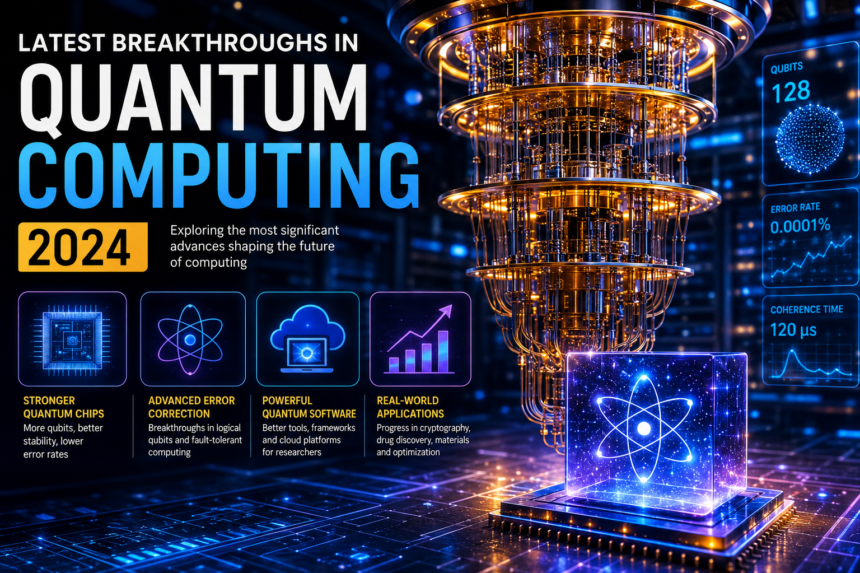
Quantum computing continued to make remarkable progress in 2024, with researchers and technology companies achieving important milestones in hardware, error correction, logical qubits, and quantum software. Although practical, large-scale quantum computers are still under development, the breakthroughs of 2024 showed that the industry is moving closer to building machines capable of solving problems beyond the reach of conventional computers.
Google’s Willow Quantum Chip
One of the biggest quantum computing announcements of 2024 came from Google with its Willow quantum processor. Introduced in December, Willow demonstrated a major improvement in quantum error correction, one of the biggest challenges facing the industry.
Google reported that Willow could reduce errors as more qubits were added, an important development because quantum systems traditionally become more difficult to control as they grow. The chip also completed a benchmark computation in less than five minutes that Google estimated would take a leading classical supercomputer around 10 septillion years.
While this benchmark does not represent a useful everyday application, it demonstrated the potential of quantum processors to perform certain specialized calculations at extraordinary speeds.
Microsoft and Quantinuum Improve Logical Qubits
Another major breakthrough occurred in April 2024 when Microsoft and Quantinuum announced an important advance in reliable quantum computing. Their researchers combined Quantinuum’s ion-trap quantum hardware with Microsoft’s qubit-virtualization technology to create four highly reliable logical qubits from 30 physical qubits.
The resulting logical qubits demonstrated an error rate approximately 800 times better than the corresponding physical qubits. The teams also reported running more than 14,000 experiments without an error.
This achievement is significant because quantum computers need reliable logical qubits rather than simply large numbers of physical qubits. Error correction allows multiple physical qubits to work together to protect quantum information from noise and other disturbances.
IBM Advances Its Heron Processor
IBM also made substantial progress during 2024. The company introduced an improved version of its Heron quantum processor with 156 qubits. IBM reported continuing reductions in error rates and significant improvements in processing speed.
According to IBM Research, Heron’s two-qubit gate error rate reached approximately 8 × 10⁻⁴ in its reported measurements, while the company’s circuit-layer operations per second increased dramatically compared with earlier generations. IBM also demonstrated new technologies designed to connect quantum chips and scale quantum systems through modular architectures.
These developments are important because building a useful quantum computer will require more than a single powerful processor. Future systems may need multiple quantum chips connected together while maintaining high performance and low error rates.
Advances in Quantum Error Correction
Quantum error correction became one of the central themes of 2024. Qubits are extremely sensitive to their environment, meaning that unwanted interactions can cause quantum information to disappear or become corrupted.
Traditional computing can use relatively stable bits, but quantum systems require sophisticated methods to detect and correct errors without destroying the underlying quantum information. Google’s Willow results were particularly important because they demonstrated that error-corrected performance could improve as the system was scaled.
Microsoft and Quantinuum’s logical-qubit demonstration provided another example of how error correction can transform unreliable physical qubits into more dependable computational resources.
Quantum Software Also Moves Forward
Hardware was not the only area of progress. Quantum software and development tools continued to mature throughout 2024. Better software is essential because researchers need efficient ways to design quantum circuits, optimize calculations, manage errors, and combine quantum processors with classical computers.
IBM highlighted the stable release of Qiskit 1.0 as an important software milestone in its 2024 research review. Qiskit provides developers and researchers with tools for programming quantum computers and experimenting with quantum algorithms.
The growth of cloud-based quantum platforms is also making quantum computing more accessible to universities, developers, and businesses without requiring them to own expensive quantum hardware.
What These Breakthroughs Mean for the Future
The breakthroughs of 2024 suggest that quantum computing is gradually moving from experimental research toward more practical engineering. However, it is important not to assume that quantum computers are already ready to replace conventional computers.
Most current quantum systems remain specialized and face major challenges involving error rates, scaling, cooling, connectivity, and software development. Google’s Willow benchmark, for example, demonstrated an extraordinary result on a specific computational test rather than proving that quantum computers are generally faster than classical machines.
Nevertheless, progress in logical qubits and error correction could eventually make large-scale fault-tolerant quantum computing possible. Potential applications include drug discovery, materials science, financial modeling, optimization, cryptography, and simulations of complex physical systems.
Conclusion
The latest breakthroughs in quantum computing during 2024 marked an important stage in the technology’s development. Google’s Willow chip demonstrated major progress in error correction, Microsoft and Quantinuum achieved highly reliable logical qubits, and IBM advanced both quantum hardware and modular scaling technologies. At the same time, quantum software continued to become more accessible and capable.
The industry still faces significant technical challenges, but 2024 demonstrated that researchers are making steady progress toward reliable and scalable quantum machines. As hardware, error correction, and software continue improving, quantum computing could become an important part of the future of high-performance computing and scientific discovery.