Introduction
The pharmaceutical industry is increasingly using data analytics and artificial intelligence to improve research, clinical development, and decision-making. Eisai, a Japanese pharmaceutical company known for its focus on human health care, has been developing its digital and data capabilities as part of this broader transformation.
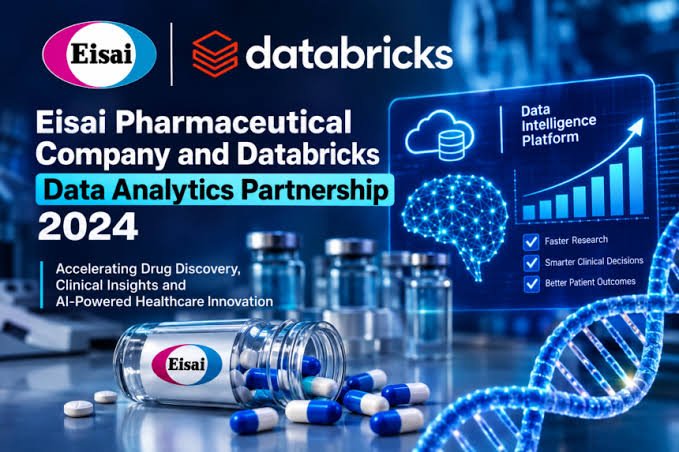
The relationship between Eisai and Databricks is particularly relevant to discussions about modern pharmaceutical data infrastructure. However, it is important to distinguish between an ongoing technology relationship and a new partnership announcement. Available 2024 information does not show a newly announced Eisai-Databricks partnership in that year. Instead, 2024 saw major developments in Databricks’ data and AI platform, while Eisai also adopted other AI-focused technologies for clinical development.
Eisai and the Importance of Data
Pharmaceutical companies generate enormous amounts of information. Research laboratories, clinical trials, manufacturing systems, patient-related datasets, and regulatory processes can all produce different types of data.
Managing these sources effectively is challenging because information may be stored across separate systems. Data scientists and researchers therefore need reliable ways to organize, analyze, and govern information before artificial intelligence can provide useful results.
For a pharmaceutical company such as Eisai, better data management can support research teams by making information easier to discover and analyze. It can also help organizations build more consistent analytical workflows across different departments.
Databricks and Pharmaceutical Data Analytics
Databricks has developed a data and AI platform designed to bring data engineering, analytics, machine learning, and AI workloads together. Its Data Intelligence Platform is intended to help organizations work with large datasets while maintaining governance and data lineage.
In June 2024, Databricks introduced AI/BI, an analytics product combining AI-powered dashboards with a conversational interface called Genie. The system was designed to allow users to ask questions about organizational data using natural language and receive analytical insights. Databricks also emphasized integration with Unity Catalog for governance and lineage.
These capabilities are relevant to pharmaceutical companies because healthcare and life-sciences organizations require strong controls around sensitive information, data quality, and traceability.
Artificial Intelligence in Pharmaceutical Research
AI can potentially support pharmaceutical research in several ways. Researchers can use machine-learning models to analyze complex datasets, identify patterns, prioritize research questions, and support decision-making.
However, pharmaceutical AI requires more than simply applying a powerful model to a large dataset. The underlying data must be accurate, appropriately governed, and understandable. This makes data engineering and analytics platforms an important part of the overall AI strategy.
Databricks has increasingly positioned its platform around this combination of data and AI. Its 2024 product developments included technologies intended to help organizations prepare data for analytics and generative AI applications.
Eisai’s 2024 Clinical Data Development
One of Eisai’s notable technology developments in 2024 involved Medidata rather than Databricks. On July 25, 2024, Medidata announced that Eisai Inc. had selected its AI-driven Clinical Data Studio.
The solution was designed to help Eisai integrate different clinical data sources and improve data review and reconciliation. Medidata stated that its technology could enable data review to be performed up to 80% faster.
This development demonstrates Eisai’s broader interest in using AI and modern data technologies to improve clinical development. It also shows why pharmaceutical organizations often use multiple specialized technology platforms rather than relying on a single vendor for every data requirement.
Data Governance and Security
Data governance is particularly important in pharmaceutical research. Clinical and scientific datasets can contain sensitive information, while research data may have significant commercial value.
Databricks’ Unity Catalog is designed to provide centralized governance, permissions, discovery, and lineage across data and AI assets. In its 2024 AI/BI announcement, Databricks highlighted the connection between AI/BI and Unity Catalog, including the ability to trace data usage and apply organizational governance policies.
For life-sciences organizations, these capabilities can be useful because researchers need access to relevant information without compromising security, regulatory requirements, or data integrity.
The Broader Life-Sciences AI Ecosystem
Databricks also expanded its life-sciences ecosystem in 2024. In May, TetraScience and Databricks announced a strategic partnership focused on scientific research, development, manufacturing, and quality control.
The companies described the collaboration as a way to make scientific data more suitable for large-scale AI applications. They highlighted use cases involving laboratory research, data analysis, quality control, and process development.
This development illustrates the broader direction of the pharmaceutical technology industry. Rather than treating AI as a standalone application, companies are increasingly building data foundations capable of supporting AI across research and operations.
Why the Relationship Matters
The significance of the Eisai and Databricks topic lies in the broader shift toward data-driven pharmaceutical development. Modern drug development produces enormous quantities of structured and unstructured information, and organizations need scalable platforms to make that information useful.
A strong data foundation can help researchers spend less time locating and preparing information and more time interpreting results. AI can then be applied to appropriate datasets for tasks such as pattern recognition, forecasting, analytics, and research support.
At the same time, AI-generated insights still require scientific validation and human oversight. Pharmaceutical decisions involve significant safety and regulatory considerations, so technology should support qualified experts rather than replace their judgment.
Future Possibilities
The combination of advanced analytics, cloud data platforms, and AI could continue to influence pharmaceutical research. Future applications may include faster analysis of clinical information, improved research workflows, better identification of patterns in scientific datasets, and more efficient collaboration between teams.
For Eisai, the continued development of digital capabilities fits with the company’s broader focus on improving healthcare through innovation. For Databricks, pharmaceutical and life-sciences organizations represent an important environment in which unified data and AI platforms can demonstrate their value.
Conclusion
The topic of the Eisai pharmaceutical company, Databricks, data analytics, and AI in 2024 reflects a much larger transformation taking place across the life-sciences industry. While there was not a clearly documented new Eisai-Databricks partnership announcement in 2024, both organizations were part of a rapidly developing ecosystem centered on data and artificial intelligence.
Databricks continued expanding its data intelligence and AI capabilities, including AI/BI and governance technologies, while Eisai adopted AI-focused clinical data technology from Medidata in 2024.
Together, these developments demonstrate an important lesson for pharmaceutical companies: successful AI depends not only on sophisticated models but also on reliable data, strong governance, scalable analytics, and responsible human oversight.